
There is a particular kind of unease that has become strangely common.
Not the sharp fear of a crisis, where the threat is clear and the response is obvious. This is different. It is the feeling that the world still functions, but it no longer settles. That even when things look “fine” on the surface, it is harder to plan, harder to commit, harder to feel confident that the same actions will produce the same results.
People talk about it indirectly.
“Everything feels harder than it should.”
“It’s like we never fully recover anymore.”
“I can’t tell what matters.”
“Even when I’m doing well, I don’t feel safe.”
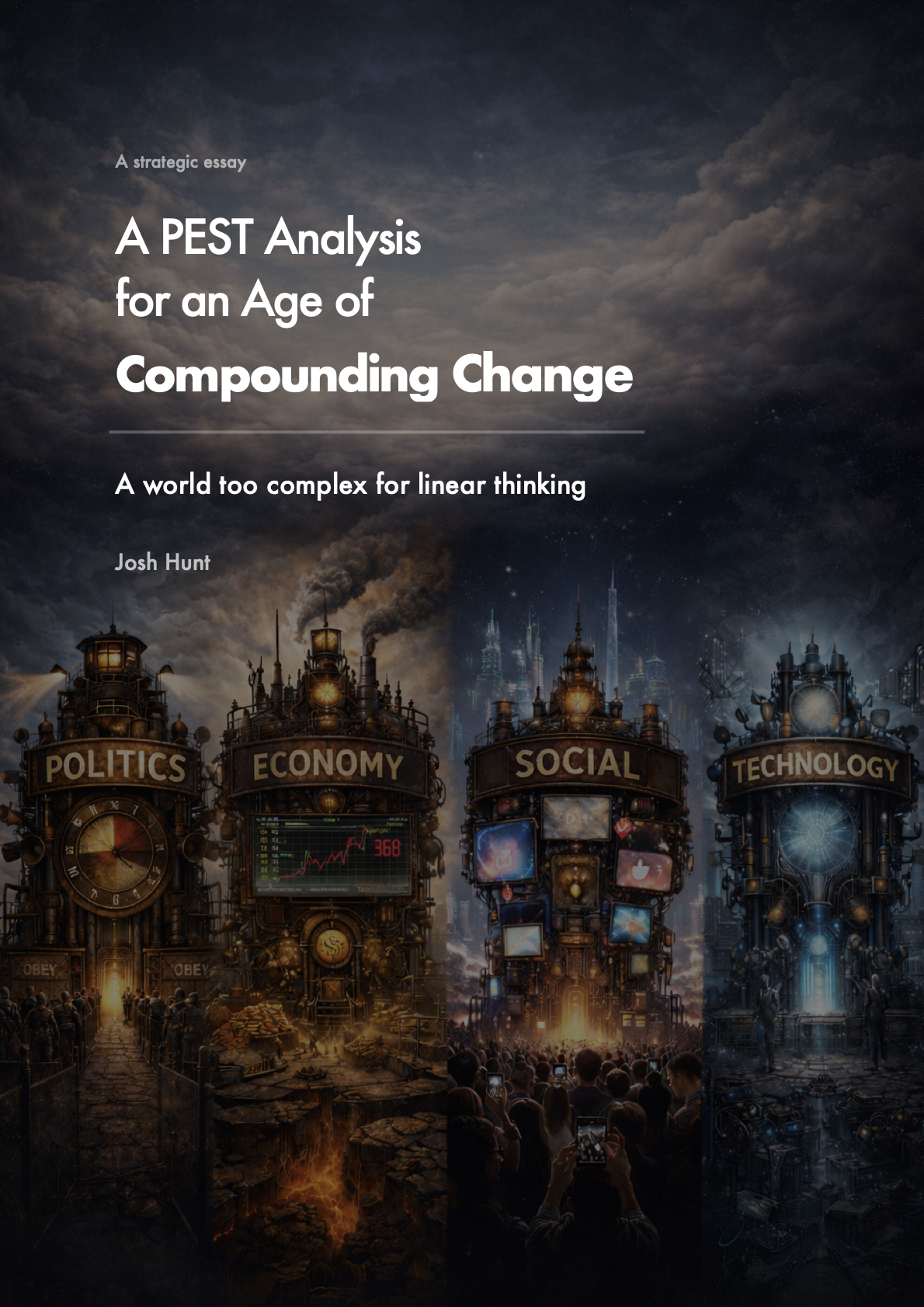
This executive summary is an attempt to name what is happening, without turning it into melodrama or doom. It is based on a collective PEST analysis that looks at the Political, Economic, Social, and Technological environment together, because the truth of this moment is that the forces are no longer separable. They are interacting constantly, amplifying each other, and compressing our sense of stability.
That is why things feel strange.
We have moved from a world shaped by occasional disruption into a world shaped by continuous compounding change.
The old rhythm is gone
For much of recent history, life had a rhythm that strategy quietly relied on.
A shock would happen. People would respond. Systems would adjust. Then a kind of normal would reassert itself, long enough for planning to become meaningful again. Organisations could build five-year strategies. Individuals could make long-range decisions and feel that the ground beneath them would remain broadly consistent.
Even when disruption arrived, the underlying assumption was recovery and reversion. That the system would settle.
The defining shift of our time is that the settling is no longer guaranteed.
It is not simply that “things change faster.” It is that changes do not come one at a time. They stack. They overlap. They cascade.
Political choices trigger economic effects within weeks. Economic pressure reshapes social trust. Social strain alters the legitimacy of institutions. Technological acceleration amplifies all of it and does so at a speed that outpaces governance, adaptation, and human capacity.
So the world still works, but it works with less slack.
And when slack disappears, everything feels more intense.
Mistakes cost more.
Delays ripple further.
Trade-offs feel sharper.
Confidence becomes harder to hold.
What “compounding change” actually means
Compounding change is not a buzzword. It is a description of the new operating conditions.
In a compounding environment:
- you can never fully isolate a problem
- causes and effects are harder to trace
- outcomes feel less linked to effort
- “doing the right thing” can still lead to a bad result
- planning horizons shrink because assumptions expire faster
That creates a particular kind of pressure, both for organisations and for individuals.
In organisations it looks like a constant state of transition. Restructures. Re-platforming. New operating models. New regulations. New tools. New expectations. All while continuing to deliver.
For individuals it looks like a constant state of self-management. Keeping up. Re-orienting. Reassessing. Adapting. Learning. Coping. Performing. All while trying to maintain a sense of self.
The PEST analysis makes one thing clear.
This is not a phase you can wait out.
It is a structural shift in the external environment.
To see why, we need to look at each domain, and then, more importantly, how they collide.
Political: politics has moved inside the business
For a long time, many businesses treated geopolitics as background noise. Relevant if you were in defence, energy, heavy industry, or a multinational with obvious exposure. For everyone else, it was something you read about, not something that shaped day-to-day operations.
That era is ending.
Politics has moved inside the operating model.
It now directly shapes:
- market access
- supply chain design
- compliance burden
- technology choices
- cost structure
- investment confidence
- reputational risk
This is one of the reasons the world feels harder. A growing number of decisions that used to be “commercial” now contain political risk, even when nobody wants to talk about it that way.
The return of blocs and the end of universal rules
The world is becoming more multipolar. Power, capital, and rule-making are no longer anchored to a single centre. That does not automatically mean global collapse. It does mean a more contested environment with fewer universal assumptions.
In a bloc-shaped world, organisations face more moments where they must navigate:
- competing standards
- different interpretations of the same principles
- rules enforced unevenly
- pressure to align with a side, even when neutrality would be preferable
This is a shift from globalisation as “default” to globalisation as “conditional.”
That condition introduces friction everywhere.
Trade as security, not efficiency
Trade policy has hardened in many regions. Supply chains are now treated as strategic terrain. Critical goods, semiconductors, energy systems, rare materials, and even data are increasingly framed through a security lens.
For organisations this changes the nature of optimisation.
The old logic prized efficiency above all. The new logic demands resilience, redundancy, and optionality, all of which cost money and time.
For individuals, it changes what it feels like to do work well. You can plan intelligently and still be caught by tariffs, controls, sanctions, shifting enforcement, or geopolitical shocks that appear overnight.
Elections, volatility, and the shrinking planning window
Elections have always mattered. What has changed is the degree of policy swing and the speed with which it can affect the real economy.
In many places, elections now introduce sharp changes in tone, policy direction, and enforcement. That means political time becomes a strategic variable. For leaders, it creates uncertainty about long-term rules. For teams, it creates fatigue, because priorities can shift with the political weather.
Energy, regulation, and hybrid risks converge
Two political realities now sit at the centre of strategy.
First, energy is increasingly treated as sovereignty. Governments intervene. Markets respond. Costs become less predictable. Transitions accelerate unevenly. Businesses inherit the complexity.
Second, hybrid threats have become persistent. Cyber risk, disinformation, interference, and disruption are not occasional incidents. They are ambient conditions.
Together these shifts erode a key stabiliser. Predictable rules.
And when rules feel less predictable, people become more cautious, not because they are weak, but because they are adapting to higher downside.
Economic: pressure without collapse
Economically, part of what makes this moment feel strange is that it resists neat labels.
It is not a clean recession story. It is not a clean recovery story.
Many headline indicators can appear stable while lived experience feels strained. That gap creates confusion.
The core economic reality is constraint.
Money is no longer cheap, neutral, or invisible
The era of ultra-low interest rates shaped behaviour in ways many people only recognise in hindsight. Cheap money reduced the cost of time. It made investment easier. It softened trade-offs. It rewarded risk and growth.
That regime has shifted.
When money becomes more expensive, the whole system behaves differently.
- investment thresholds rise
- caution increases
- refinancing becomes a strategic issue
- cash flow becomes a board-level obsession
- small inefficiencies matter more
In that environment, activity continues, but it feels heavier. Decisions are slower, not because people lack imagination, but because the cost of being wrong has risen.
Costs stabilise, but they do not reset
One of the most psychologically important dynamics of the last few years is this.
Inflation may fall, but prices often do not return to previous levels.
This creates a persistent grind. Organisations work harder to defend margins. Households work harder to preserve living standards. It can feel like you are running, yet staying in roughly the same place.
That is not a temporary inconvenience. It is a structural source of strain.
Demand exists, but it is harder to read
Demand does not disappear in a constrained environment. It becomes harder to interpret.
Consumers and businesses trade down. Delay decisions. Switch more quickly. React to uncertainty. They become more value-sensitive. They seek confidence before committing.
This creates volatility. You can be right about the fundamentals and still be surprised by short-term behaviour. It also creates a feeling of instability because the signals do not align cleanly.
Labour feels tight and tense at the same time
Another paradox of this period is the way labour can feel scarce while people also feel insecure.
Skill shortages persist in many areas. Yet confidence weakens. Hiring becomes cautious. Restructuring rises. Workloads intensify. Burnout spreads.
People can feel both needed and disposable, sometimes inside the same quarter.
That combination is corrosive. It erodes trust and it makes long-term commitment harder.
Social: the capacity crisis
If the political and economic environment explain much of the external friction, the social environment explains why it lands the way it does.
The social layer is about capacity.
How much change can people absorb before they begin to resist, fragment, or withdraw?
The PEST analysis argues that social capacity has become a limiting factor, and that is a big reason why even good strategies can stall.
Trust is thinner, interpretation is sharper
In a higher-trust world, people grant goodwill. They tolerate ambiguity. They give institutions time. They assume mistakes are mistakes, not malice.
In a lower-trust world, interpretation comes first.
Decisions are read through identity, fairness, power, and legitimacy before they are evaluated on their merits. That does not mean people are irrational. It means the context has changed the way meaning is made.
This affects organisations directly.
Comms that once would have landed as neutral now trigger suspicion. Policy changes become symbolic battles. Brands are expected to take positions. Institutions face legitimacy questions faster.
The environment becomes emotionally reactive because trust is no longer acting as a shock absorber.
Inequality and perceived unfairness
Perceived unfairness is not only about income. It is about access, opportunity, security, and dignity.
When people feel the game is rigged or the rewards are distributed unfairly, cooperation becomes harder. Cynicism rises. Conspiracy thinking finds fertile ground. Social cohesion weakens.
This feeds back into politics, which then feeds back into economics.
Relationships and community are reconfiguring
We are also in the midst of a long shift in relationships, intimacy, family structures, and community.
Traditional anchors have weakened in many places. People still find connection, but often in different forms, sometimes more fragmented, sometimes more transient.
When social bonds become less reliable, stress travels further into daily life.
People carry more alone.
And that means their ability to absorb volatility declines.
The quiet exhaustion
One of the most consistent human signals in this period is exhaustion.
Not only from work, but from re-orienting repeatedly.
From living with background uncertainty.
From feeling that progress requires disproportionate effort.
From being asked to adapt, again and again, without recovery time.
This is not just a personal issue. It is a strategic constraint. Burnt-out societies and burnt-out organisations cannot execute bold transformations easily.
Which matters enormously, because the technological layer is accelerating, whether we are ready or not.
Technological: more capability, less confidence
Technology is often framed as the hopeful quadrant. Innovation, productivity, better tools.
But the collective PEST analysis reaches a more nuanced conclusion.
Technology is not reducing uncertainty. It is accelerating it.
The acceleration gap
The first technological reality is that the pace of change now exceeds the pace of adaptation.
New tools arrive before old ones stabilise. Organisations roll out platforms while still learning the last one. Individuals are expected to stay competent in environments that keep shifting.
This creates shallow adoption, fragmented workflows, and decision compression.
It also creates a psychological effect.
A permanent sense that you are behind.
Even when you are performing well.
AI as a capability shock
AI is not just “another tool.” It changes what organisations can do, and it changes that faster than governance, ethics, skills, and professional identities can recalibrate.
That creates both opportunity and instability.
Opportunity because capability expands quickly.
Instability because:
- job boundaries blur
- expertise becomes less durable
- verification becomes more important
- trust in outputs becomes a new problem
- organisational power shifts toward those who can orchestrate systems
In other words, AI increases leverage, but it also increases the stakes of decision-making.
Human limits surface sooner
Continuous change surfaces human limits sooner.
A big part of the modern experience is the absence of recovery time. Not just between crises, but between waves of transformation. Tools, policies, social expectations, and operating conditions keep shifting.
That produces:
- change fatigue
- confidence erosion
- attention fragmentation
- boundary collapse
- quiet disengagement
People still deliver, but the cost rises.
Digital progress meets physical constraint
The final technological point reconnects the whole PEST analysis back to the real world.
The most powerful technologies are physical.
AI, cloud, and real-time systems depend on data centres, energy, cooling, water, hardware supply chains, rare materials, and stable grids.
Digital progress is colliding with infrastructural limits.
That means technology strategy is also energy strategy, supply chain strategy, and political strategy.
The old story of “weightless” digital scale fades.
The new story is conditional scale.
The simplest answer to “why does everything feel strange?”
Because the stabilisers are weaker.
For decades, much of modern life was held up by a set of hidden supports:
- a belief in broadly predictable rules
- a belief in economic normalisation after shocks
- a belief that institutions could coordinate effectively
- a belief that social trust could absorb friction
- a belief that technology would create more control than chaos
Those supports have not vanished, but they have weakened.
And when stabilisers weaken, the world feels more volatile even when it is functioning.
This is what people are picking up intuitively.
Not that collapse is inevitable.
But that stability is no longer automatic.
Stability has become a task.
What this means for organisations and individuals
This executive summary is not meant to prescribe a neat solution, because neat solutions are part of the old world. The compounding environment does not reward overly tidy narratives.
But it does suggest a handful of grounded implications.
1) Planning must evolve from prediction to preparedness
Base-case planning is fragile when assumptions expire quickly. Scenario thinking becomes normal. Not as paranoia, but as realism.
2) Resilience is not a slogan, it is a cost structure
Buffers, redundancy, optionality, and simplification are strategic decisions. They look inefficient in stable times. They become decisive in compounding times.
3) Capacity is the constraint
The social environment determines how much change people can absorb. Sequencing matters. Coherence matters. Recovery time matters. Strategy must respect human limits.
4) Technology needs governance, not just adoption
Tool rollouts without alignment, guardrails, and clarity create hidden debt. AI raises the need for verification, ethics, and accountability. Capability without governance creates risk. However, equally there is a balance to be found, too much governance will lead to inertia.
5) Do not personalise a structural mismatch
Many people feel as if they are failing because work and life feel harder. But the pattern is too widespread to be explained by individual weakness, at all levels.
The environment changed character.
Confusion and fatigue are signals of structural change, not proof you are broken.
Closing: orientation is underrated
Understanding the environment does not remove pressure, but it changes how you carry it.
It explains why competence can still feel insecure.
Why execution feels heavier.
Why progress demands more energy.
Why so many people and organisations share the same quiet disorientation.
The strange feeling is not a mystery once you see the pattern.
Political volatility, economic constraint, social strain, and technological acceleration are interacting continuously. The forces compound. They reduce slack. They weaken stabilisers. They make stability something we have to build deliberately, rather than assume.
That is the age we are in.
An age of compounding change.
And if there is one honest takeaway worth holding close, it is this.
You are not alone in feeling it.
The world did not get harder because you became less capable.
The operating conditions changed.