

This article is connected to a wider research project I have published on the state of modern marketing. If you want the deeper, source-heavy version with a fuller evidence base, you can read it here: Marketing at an Inflection Point: A Structural Diagnosis, and the Strategic Shifts Required Now. This piece is intentionally written as a standalone.
I did not set out to write something like this.
For most of my career, marketing felt legible. Not easy. Not always fair. But legible. You could build a plan, place your bets, watch the signals, adjust, learn, improve. You could feel the relationship between effort and outcome. You could develop instincts that worked more often than they did not.
And for a long time, that was enough.
But over the last few years, I have felt a change in the texture of the work that I do. I’ve seen myself spending more and more time on defending marketing’s role than focusing on the work of marketing itself.
I have watched good marketers get tied in knots trying to prove impact with weaker and weaker signals. I have seen boardrooms grow sceptical. Budgets tighten. Targets stay the same. I have seen performance drop for no obvious reason. I have watched data quality erode. Platforms change the rules overnight. And I have seen marketing’s very existence questioned by senior execs who want simple answers in what is an increasingly “messy” world.
It is not just that marketing got harder. It is that it got stranger.
Stranger in the way people talk about it. Stranger in the way organisations demand certainty while making it structurally harder to find. Stranger in how the work can look busy and productive while feeling weirdly disconnected from real-world impact.
And that is why I believe marketing is having a moment.
Not a “golden age” sort of moment. Far from it.
A moment of truth.
A moment where the profession is being forced to look at itself and ask a harder question.
What is marketing actually for now, and how do we know it is working?
What I mean when I say marketing is having a moment
When I say marketing is having a moment, I am not saying marketing is dead.
People still buy things. Brands still win. Demand still exists. Human psychology has not been rewritten.
But I do think something fundamental has shifted.
The environment marketing operates inside has changed faster than most marketing operating models have.
That mismatch creates predictable symptoms.
More reporting. Less confidence.
More tools. Less clarity.
More output. Less distinctiveness.
More performance. Less belief.
More pressure. Less slack.
More platform dependency. Less control.
And when enough teams feel those symptoms at the same time, the profession starts asking existential questions.
You can feel it on LinkedIn. You can hear it in marketing meetings. You can read it in the quiet desperation of anonymous posts you see on Reddit.
Not because marketers suddenly became incompetent.
Because the game changed.
I’m not the only one who has noticed
For a while, I assumed this was just me.
Maybe I was tired and burned out. Maybe I had been too deep in the day-to-day. Maybe I had hit that point in a career where everything starts to feel a bit heavier and less exciting. Maybe I’m just too cynical (a shortcoming I’m very aware of).
But the more I’ve spoken to other marketers, and the more I’ve looked around, the harder it became to keep that story.
Because this feeling is everywhere.
It shows up in the way people talk about their jobs now. It shows up in the way marketing teams are measured and managed. It shows up in the way leaders talk about budgets and certainty. And it shows up very clearly in the data signals too.
Not as one dramatic, headline statistic. More as a pattern.
A pattern that says… something is shifting.
Signal one: search interest tells a story
One of the cleanest “temperature checks” we have is search.
When a topic becomes more confusing, more pressured, or more urgent, people start searching for help. They search for explanations. They search for tools. They search for reassurance that they are not losing their minds.
In my research, the search trends were hard to ignore.
If we begin by looking at a base level, here are two charts that tell an interesting story…
First of all we have a chart, using global data pulled from Google Trends. The chart below is search interest over the last 22 years for the query “does marketing work”.
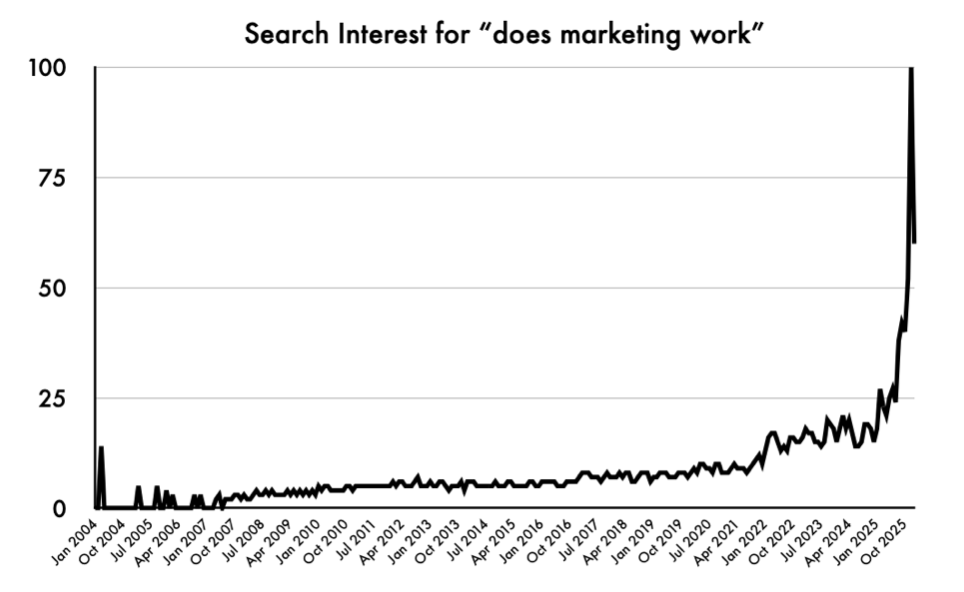
What’s interesting about this data, is the fact that this query steadily started growing from its mean back in 2021, during the pandemic, and then exploded towards the end of 2025.
This explosion in search interest then correlates with another, more existential query being asked… is marketing dead?
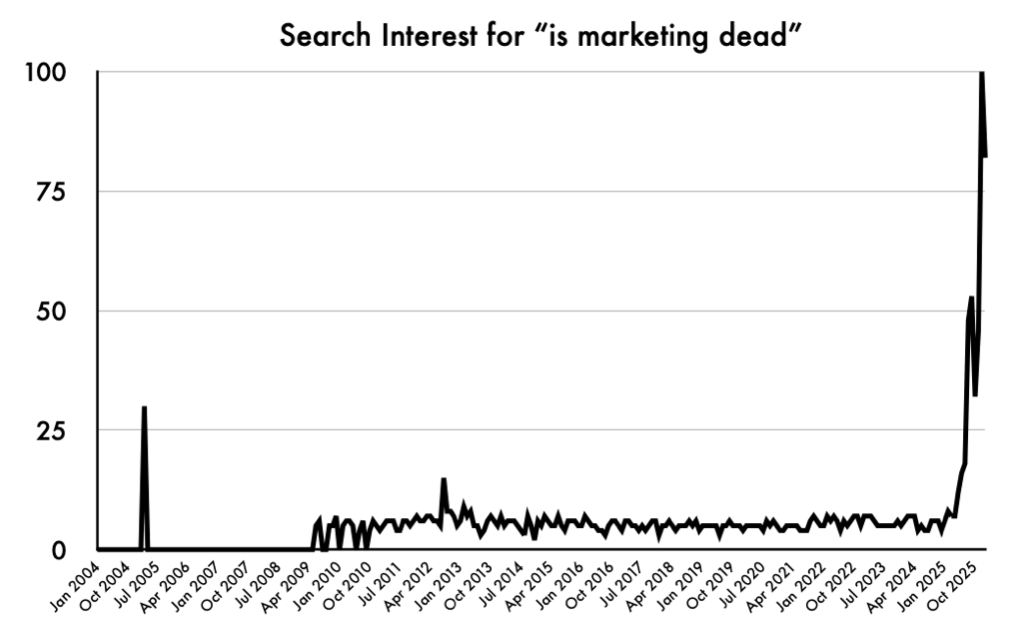
Whilst we don’t have the steady build-up in this trend that we saw in the data related to “does marketing work”, we do have the explosion in interest towards the end of 2025.
And it isn’t just evident in these existential questions being asked in Google searches right now. You can see rising interest in things like:
- marketing measurement and attribution
- incrementality and marketing effectiveness
- marketing mix modelling
- brand versus performance tension
- ad fraud, bot traffic, and viewability
- attention metrics and creative effectiveness
- AI in marketing, marketing automation, and “AI replacing jobs”
None of these searches prove a single point on their own. But taken together, they paint a picture. They suggest an industry trying to re-orient itself in real time.
This is what a profession looks like when its default assumptions start to wobble.
Signal two: the anonymous chorus is getting louder
The other place this shows up is the place where people are most honest.
Not the stage. Not the polished LinkedIn posts. The anonymous channels. The forums. The Reddit threads. The places people go when they are too tired to perform competence.
That is where you see the raw version.
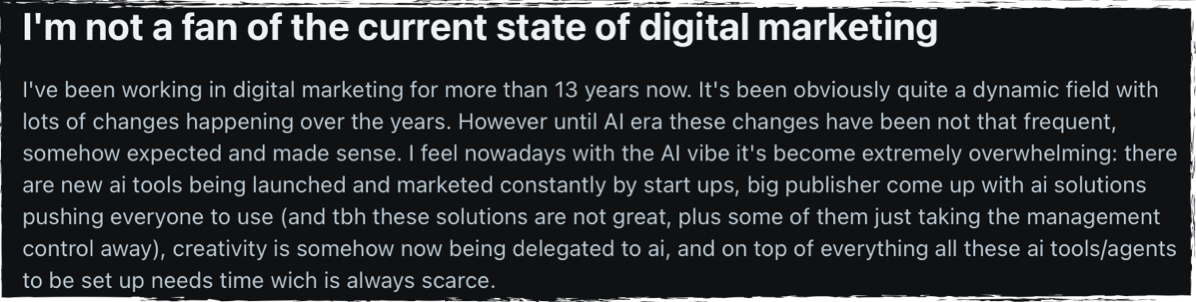
Here’s a good example of someone feeling totally overwhelmed from the expectations brought about by AI…
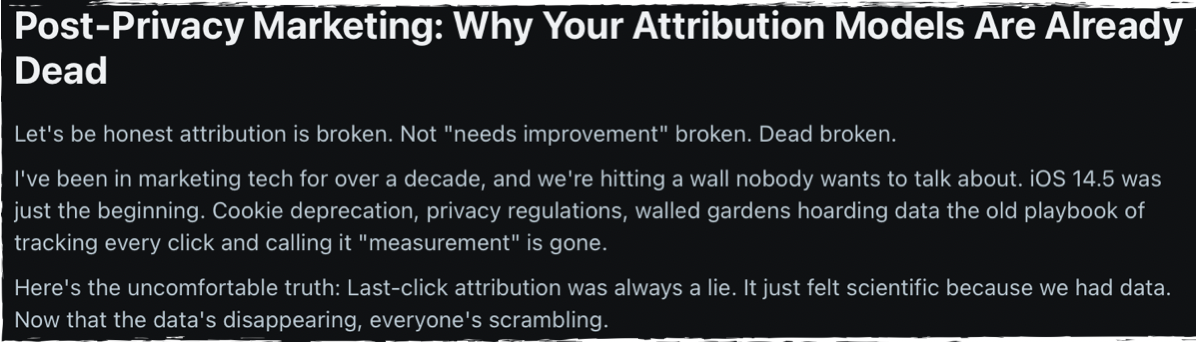
And here is another Redditor discussing how cookie deprecation, privacy regulation and the “walled gardens” the platforms have become has essentially destroyed attribution measurement…
And finally, here is an example of a marketer being asked to prove the value of marketing to finance and engineering teams.

The same themes repeat…
- targets rising while budgets shrink
- pressure to prove impact with weaker tracking
- attribution being treated as truth when everyone knows it is partial
- performance dropping without clear causes
- more tools, more reporting, more complexity
- the feeling that marketing is becoming a credibility battle, not a growth function
- AI accelerating output but not necessarily improving outcomes
And the thing that gets me is not the complaining. Every industry complains.
It is the consistency.
Different sectors. Different seniority levels. Different company sizes.
Same underlying tension.
It is not just a few burnt out people. It is a shift in the environment.
Signal three: the mood has changed in the room
And then there is the signal you cannot chart, but you can feel.
The mood.
Marketing used to be an engine people wanted to add fuel to.
Now, in a lot of organisations, it feels like a line item that has to be defended.
This is that age-old debate over whether marketing should be seen as a “cost” or an “investment”.
The conversation has shifted from “how do we grow?” to “how do we prove?”
From “what do we build?” to “what can we measure?”
From “how do we earn attention?” to “what can we attribute?”
That is not because leaders are bad people or marketers have lost their craft.
It is because the environment has changed.
And when the environment changes, the way organisations behave changes too.
So no, this is not just me.
It is broader than that.
And once you accept that, the next question becomes easier to ask.
What does this look like in day-to-day reality?
A scenario you will recognise: a week in modern marketing
Let me describe a week I have seen in different forms across different companies. It is a composite, but if you have been in this world recently, it will feel uncomfortably familiar.
Monday: the credibility meeting
The week opens with performance. It is always performance.
Revenue is under scrutiny. Pipeline is under scrutiny. Costs are under scrutiny. And marketing, because it is visible spend and partly intangible value, is under scrutiny by default.
Someone asks a question that seems simple.
What drove the result?
You have an answer, but it is not satisfying. It is not a neat lever-pull story. It is multi-causal. It is messy. It is full of “we think” and “it is likely” and “there is a lag” and “we cannot fully see that anymore.”
You start speaking, and you can feel the room’s patience thinning. Not because people are unreasonable, but because uncertainty is expensive now. Everyone is carrying too much of it.
Then Sales talks. Their answer is a narrative. A clean story. It may even be true. But it is easier to hold. And it lands better in a room that wants certainty.
You leave the meeting thinking something you cannot really say out loud.
We are not even debating marketing. We are debating belief.
Tuesday: the KPI maze
Your dashboard has grown again.
Every new question becomes a metric. Every new metric becomes a chart. Every new chart becomes a meeting. Every meeting becomes a performance.
And slowly, measurement stops being a tool for learning and starts becoming a tool for control.
The team spends more time preparing to explain the work than doing the work.
And the most dangerous part is how normal it feels.
Wednesday: the wobble
Performance moves in a way you cannot fully explain.
Maybe paid efficiency dips. Maybe conversion rate shifts. Maybe organic demand softens. Maybe traffic rises but revenue does not. Maybe everything looks stable but something feels wrong.
You do what professionals do. You investigate.
But the investigation is slower now. Data is patchier. Journeys are more fragmented. More happens on-platform. More happens in dark social. More happens across devices. More happens in places you cannot see.
So the wobble creates a familiar feeling.
You are trying to understand a system that no longer wants to be fully understood.
Thursday: AI enters the room
Someone has seen a demo.
A campaign plan generated in seconds. A deck assembled instantly. A dozen concepts spat out like a slot machine of competence.
And the unspoken question arrives.
If AI makes marketing faster, why do we still need so much budget and headcount?
AI can increase output. It can reduce friction. It can accelerate execution.
But it does not automatically create clarity. It does not automatically create distinctiveness. And it definitely does not automatically create trust.
Yet expectations rise with capability.
So the team feels pressure from both sides.
Produce more.
Prove more.
With less signal.
In a noisier world.
Friday: the quiet realisation
By Friday afternoon, you have been busy all week. Your calendar is full. Your Slack is on fire. Your dashboards are updated. Your slides are polished.
And yet, privately, you feel something that is hard to admit.
Are we actually moving anything?
That is the moment.
Not marketing is failing. But marketing is being asked to operate in conditions that make traditional certainty and leverage harder to find.
And once enough people feel that, the profession starts looking at itself differently.
Does this resonate?
If after reading that, you recognise a lot of this in your day-to-day, then you're living in the moment I'm describing, right now. Which takes us on to some of the forces driving this reality.
The first force: a media environment where delivery is not attention
Let me say something plainly, without performing shock.
A large amount of advertising is paid invisibility.
Not because all ads are bad. Not because marketers are lazy. Because we have built an ecosystem that rewards delivery metrics, and delivery is not the same thing as attention.
Kantar has been explicit on this point. Their work on attention and creative effectiveness argues that viewability is not enough, and that you need measures that capture the depth and quality of attention, not just whether an ad was technically on screen.
You can buy impressions that are technically served, technically viewable, technically in-target, and still land absolutely nowhere in a human mind.
And here is the uncomfortable part.
Most people in marketing already know this. We just do not always say it out loud, because once you say it out loud, you have to deal with what it implies about spend, optimisation, and internal reporting.
The gap between what the system reports and what humans actually notice is one of the reasons marketing feels so contested right now. You can see this in how the verification world is shifting. DoubleVerify’s Global Insights Report highlights the rising priority of attention-based measurement among media buyers, and reports major growth in adoption of attention measurement.
Then you layer in a darker truth.
Fraud and bot traffic are not edge cases
Bots inflate sessions. Invalid traffic pollutes analytics. Fraud distorts optimisation. And once you accept that even a small percentage of activity might be non-human or low-quality, it casts a shadow over everything.
This is not a fringe concern. The Trustworthy Accountability Group (TAG) has published a dedicated US Ad Fraud Savings Report that quantifies the economic scale of fraud risk and the savings attributed to anti-fraud standards and programs. You do not build industry-wide programs like that to solve a tiny problem.
Because marketing relies on feedback loops.
Spend leads to exposure. Exposure leads to behaviour. Behaviour leads to outcome. Outcome leads to optimisation.
If behaviour is contaminated, the loop lies.
And if the loop lies, internal trust collapses.
That is why fraud is not just a digital media problem. It is an organisational belief problem.
Once belief drops, every number feels more negotiable.
And marketing becomes a credibility trial.
The second force: data is getting weaker, while demand for proof is getting stronger
There was a period where digital marketing gave organisations a dangerous idea.
That we could see everything.
That we could attribute outcomes cleanly.
That we could prove causality at a granular level.
That marketing could become a machine of predictable optimisation, if only we instrumented it enough.
That idea shaped expectations.
And now those expectations are colliding with reality.
Reality looks like this.
Privacy regulation and consent barriers. Platform walled gardens. Cross-device and cross-channel fragmentation.More modelling, more inference, less direct observability. More “we think” and “it is likely” than leaders want to hear.
Apple’s introduction of App Tracking Transparency (ATT) is one of the clearest symbols of this shift. Apple itself published an extensive review of ATT and its impact on mobile advertising and measurement, and academic work has also documented the behavioural and economic effects of changes in tracking availability.
The fact this became a competition issue also matters. Reuters reported that France’s competition authority fined Apple in connection with its implementation of ATT, illustrating that these are not minor technical changes but ecosystem-level shifts with economic consequences.
On the browser side, Google’s third-party cookie and Privacy Sandbox trajectory has been publicly scrutinised and revised under regulatory attention. The UK Competition and Markets Authority describes Google changing course on cookie removal and moving toward user choice rather than full deprecation, after years of investigation.
So marketers get squeezed between two forces.
Visibility declines. Proof demand rises.
That creates a cultural trap.
You are expected to speak with confidence while living with uncertainty.
And that is how attribution becomes theatre. Not because people are lying, but because the organisation demands a clean story and the system no longer provides clean truth.
It turns measurement into performance.
It turns strategy into defence.
It turns marketing meetings into narrative fights over what the numbers mean.
If you have felt that, you are not alone.
The third force: attention is scarcer, and the noise floor is rising
Even if fraud did not exist, even if tracking was perfect, marketing would still be operating in a more hostile attention environment than it was built for.
The simplest version is this.
Supply of content and advertising has exploded. Human attention has not.
So the noise floor rises. And when the noise floor rises, good enough becomes expensive.
Because generic work does not just underperform.
It burns budget by buying delivery without creating memory.
This is the practical implication of what firms like Kantar are arguing when they frame attention as the bridge between exposure and effectiveness. If attention quality is not there, “served” and “viewed” are weak proxies for impact.
This is part of why marketing feels like it is on a treadmill.
More creative variants. More posts. More campaigns. More tests.
But the marginal gain from more feels smaller.
And now AI arrives and makes this dynamic even sharper.
Because AI does not just increase output for you. It increases output for everyone.
Which means the default state of the environment becomes abundance plus sameness.
In that environment, what becomes scarce?
Distinctiveness. Taste. Credibility. Trust. Attention that actually lands.
You do not win by producing more. You win by producing work that is meaningfully different and strategically coherent enough to cut through.
And that is a far harder problem than “make another ad”.
The fourth force: the business environment is not friendly to marketing right now
This part matters, because it is easy to make marketing feel like the problem.
But marketing does not operate in a vacuum.
Right now, businesses are dealing with a stack of pressures that make marketing harder to justify and harder to execute well.
Economic uncertainty and cost pressure. Higher scrutiny of discretionary spend. Tighter capital and tougher performance expectations. Shorter planning horizons. Lower tolerance for ambiguity.
You can see the organisational expression of this in budget behaviour. Gartner’s Annual CMO Spend Survey reported average marketing budgets falling to 7.7% of company revenue in 2024, down from 2023, and then flatlining at the same level in 2025. Gartner itself describes this as CMOs pursuing growth in an “era of less”.
At the same time, the advertising economy continues to grow in aggregate. The IAB and PwC Internet Advertising Revenue Report for full year 2024 reports record US digital advertising revenue of $259 billion, up 15 percent year over year. That combination is part of the strange tension many teams feel. The overall market can be booming while individual teams feel more constrained, more scrutinised, and more pressured to justify every line.
Marketing, by nature, often requires patience. Consistency. Compounding learning. Brand building that does not pay off in a neat weekly chart.
But the business mood right now is often the opposite.
Shorter term. More proof-driven. More risk-averse. More “show me now.”
That shifts organisational incentives in a predictable way.
More focus on near-term conversion. Less willingness to invest in upstream demand creation. More pressure on measurable channels. More fear of waste.
And here is the paradox.
The more you push spend toward the measurable bottom, the more you starve the conditions that make the bottom efficient.
So teams end up stuck in a loop.
Performance gets harder. You squeeze harder. Performance gets harder again.
It is a fragility machine.
AI: the accelerant that makes the moment unavoidable
AI did not create marketing’s moment. But it is absolutely intensifying it.
Because AI changes three things at once.
1) It makes output cheap
And when output becomes cheap, volume becomes the instinctive response to pressure.
More content. More creatives. More experiments.
But abundance does not solve attention scarcity.
Often it makes it worse.
This is one reason attention measurement is getting pulled forward. DoubleVerify’s Global Insights reporting explicitly connects the rise of attention measurement with a changing measurement environment and the need for better quality signals than viewability alone.
2) It raises expectations inside organisations
If AI can generate work in seconds, the assumption becomes:
We should ship faster. We should test more. We should be able to prove more. Outcomes should improve because efficiency.
But AI does not magically restore observability. It does not magically create differentiation. It does not magically make consumers care.
It increases production capability while leaving the deeper problems intact.
So the expectation gap grows.
3) It makes polished sameness the default
AI can make mediocre work look competent.
And when everyone can produce competent work, competence stops being a differentiator.
Taste becomes the differentiator. Strategy becomes the differentiator. The ability to see the system clearly becomes the differentiator.
But many organisations respond by doing the opposite. They cut the strategic layer and demand more execution.
That creates a bleak outcome.
More output. Less meaning. More activity. Less advantage.
The existential questions people are now asking
This is the part you can feel, even if you do not say it out loud.
Marketers are asking…
Is my job becoming making reports about marketing? Am I creating value, or just feeding platforms? Why does it feel like the work matters less while the pressure grows?
Leaders are asking…
Why are we spending more and believing less? Why does marketing feel harder to trust now? Are we measuring reality, or are we measuring a proxy of a proxy of a proxy?
And the uncomfortable truth is this.
In many organisations, marketing is simultaneously more necessary and more contested. Competition is brutal. Distribution matters. Growth is hard. Signals are weaker. Trust is lower. Spend is visible. Outcomes are messy.
That combination creates existential heat.
It is not surprising that the profession is having a moment.
Same targets. Smaller budget. More scrutiny. Attribution as performance art. More reporting than marketing.
AI increased output, not clarity. Performance dropped, and nobody can explain why.
So what do we do with this moment?
If marketing is having a moment, the worst response is to panic and double down on the behaviours that created the fragility in the first place.
More dashboards. More attribution sophistication. More martech. More output. More short-term optimisation. More “prove it weekly” culture.
Those things look like control. But in a low-visibility, high-noise world, they often increase complexity without increasing confidence.
A better response is to accept the new reality and upgrade how marketing is run.
Here is the reframing that I think matters most.
We are moving from an era of marketing as a trackable optimisation engine, into an era of marketing as a compounding system run under partial visibility.
That does not mean stop measuring.
It means measure differently, and govern differently.
It means shifting from:
Attribution certainty to calibration.
Dashboard worship to decision quality.
Output volume to distinctiveness.
Channel excellence to distribution strategy.
Campaign thinking to compounding thinking.
In plain English:
Less pretending. More judgement. More coherence.
More focus on the upstream conditions that make performance efficient, rather than just squeezing the bottom of the funnel until it screams.
A closing thought: this might end up being the best thing that happens to marketing
I know this article sounds like a diagnosis. In some ways it is.
But I do not see this moment as purely negative.
I think marketing is being forced to mature.
The easy leverage era, where you could buy cheap attention, track it neatly, and scale it predictably, is fading.
But the deeper craft is still alive.
Understanding people. Building trust. Creating memory. Making the offer feel inevitable. Earning attention rather than renting it forever. Building systems that compound.
Human psychology has not changed.
But the environment has.
So marketing is not dead.
It is just being asked to evolve.
And that is what I mean when I say marketing is having a moment.
A moment where the profession has to stop running on autopilot.
A moment where we have to rebuild belief inside organisations, inside markets, and sometimes inside ourselves.
If you have felt this shift too, I would love to hear what you are seeing. Because if marketing is having a moment, it is not just mine.
It is ours.