

I have been brought into a lot of “marketing isn’t working” situations over the years.
Sometimes it is a marketing problem. Weak execution. Unclear positioning. Poor creative. Lazy segmentation. A channel mix that has drifted into habit over impact.
But in my experience, the cases that feel most frustrating (the ones where a smart team is working hard and still getting blamed) usually share a different root cause…
The business cannot clearly articulate how it wins.
Not in a slogan. Not in a brand deck. Not in a mission statement. In practical, operational terms, who we are trying to win, why they would choose us over alternatives, what we will not do, and what must be true for growth to happen.
And it sounds really basic and simple doesn’t it? But the reality is, articulating “how we win”, is extremely difficult to do. Because to get to that simple statement, requires difficult decisions, trade-offs, understanding, agreement, and belief that the focus we’re creating, is right.
When that clarity is missing, marketing still has to ship. It still has to pick an audience, craft a message, choose channels, justify spend, forecast outcomes, and report progress. So marketing does the only thing it can do…
It invents a narrative the company can operate on.
And because marketing’s raw materials are customer insight, messaging, creative, and distribution, that narrative tends to skew towards what marketing can see and influence. It becomes a marketing-biased strategy.
It may sound compelling. It may even perform in the dashboards. But if it is not grounded in product economics, operational constraints, sales reality, retention dynamics, and pricing power, it will not hold. And when it breaks, marketing wears it. Something I’ve covered extensively in my other articles Why I Believe Marketing is Having an Important Moment and also Attribution Theatre and the Damage it Does to Modern Organisations.
This is why I think marketing can’t outrun a missing strategy. Marketing can amplify clarity. It cannot replace it. And I’m confident, that many of you reading this now, will be nodding along with me as we move on.
The symptoms: what “marketing isn’t working” looks like in the wild
If you have been around leadership teams for long enough, you will recognise this pattern…
- Goals constantly shifting: “we need leads” becomes “we need brand” becomes “we need retention” becomes “we need pipeline now”.
- Channel sprawl: “we need to be everywhere” because no one can say what actually matters most.
- Output inflation: more content, more campaigns, more initiatives, more martech, more agencies.
- Dashboard inflation: more metrics, more weekly reporting, more analysis, more attribution.
- Intensifying scrutiny: marketing becomes the easiest line item to interrogate because it is visible spend.
Confidence drops. The organisation asks marketing for more certainty. Marketing responds with more activity and more reporting. Everyone gets busier. Very little gets clearer.
Gartner has started to put language around this reality. In a survey of CMOs, they describe “strategic dysfunction” as confusion and conflict caused by unclear, too many, or conflicting enterprise objectives that marketing must support. They found 84% of CMOs report high levels of this strategic dysfunction, and organisations with high dysfunction are 36% less likely to report strong business and marketing performance.
That is the modern environment many marketing teams are operating inside. It is not a simple “do better marketing” problem. It is often an “objectives and strategy clarity” problem.
And that takes us to the uncomfortable root.
The root cause: missing strategy clarity (and what that actually means)
A missing strategy is not “no plan”.
Most businesses have plans. They have budgets, targets, initiatives, roadmaps, OKRs, and more.
A missing strategy is the absence of a shared, stable answer to four basic questions…
- Where are we playing? (which customers, which use cases, which market segments)
- How do we win there? (what is our edge, why us)
- What are the trade-offs? (what are we not doing)
- What must be true? (assumptions we are betting on)
When those answers are unclear, everything downstream starts to wobble...
- Messaging becomes generic because the business has not committed to a specific customer and a specific advantage.
- Channel strategy becomes habit-based because no one can articulate the mechanism of growth.
- Measurement becomes noisy because the organisation is trying to prove impact without agreeing what “winning” looks like.
This is not a niche theory, by the way. Research going back decades has explored the performance implications of matching marketing strategy to business strategy. One classic paper in Strategic Management Journal is literally titled “Marketing’s contribution to the implementation of business strategy” and assesses performance implications of matching marketing to business strategy.
More recently, empirical research has examined alignment between business strategy, IT strategy, and marketing strategy and its relationship to firm performance. While contexts vary, the direction is consistent: alignment matters, and misalignment erodes performance.
So when I say “missing strategy is the root cause”, I am not saying marketing has no role. I am saying marketing is not built to compensate for the absence of strategic choices.
Which brings us to the provocative question.
Does “marketing strategy” actually exist?
I want to say this carefully, because it is easy to sound like I’m dismissing an entire discipline.
Marketing strategy exists in the sense that there are strategic decisions inside marketing… positioning, segmentation, route-to-market, distribution logic, budget allocation, demand creation vs capture, and time horizon trade-offs.
But in practice, what most organisations call “marketing strategy” tends to be one of two things…
- Business strategy translated into go-to-market choices, or
- A channel plan wearing a strategy costume
Here is the distinction that I believe matters…
- Business strategy is the set of choices about where you play and how you win.
- Marketing strategy is how you create and capture demand in service of those choices.
- The marketing plan is the actual set of activities and outputs.
When business strategy is clear, marketing strategy becomes powerful because it is working inside constraints. It can optimise. It can innovate. It can build compounding assets. It can choose distribution paths that reinforce the company’s edge.
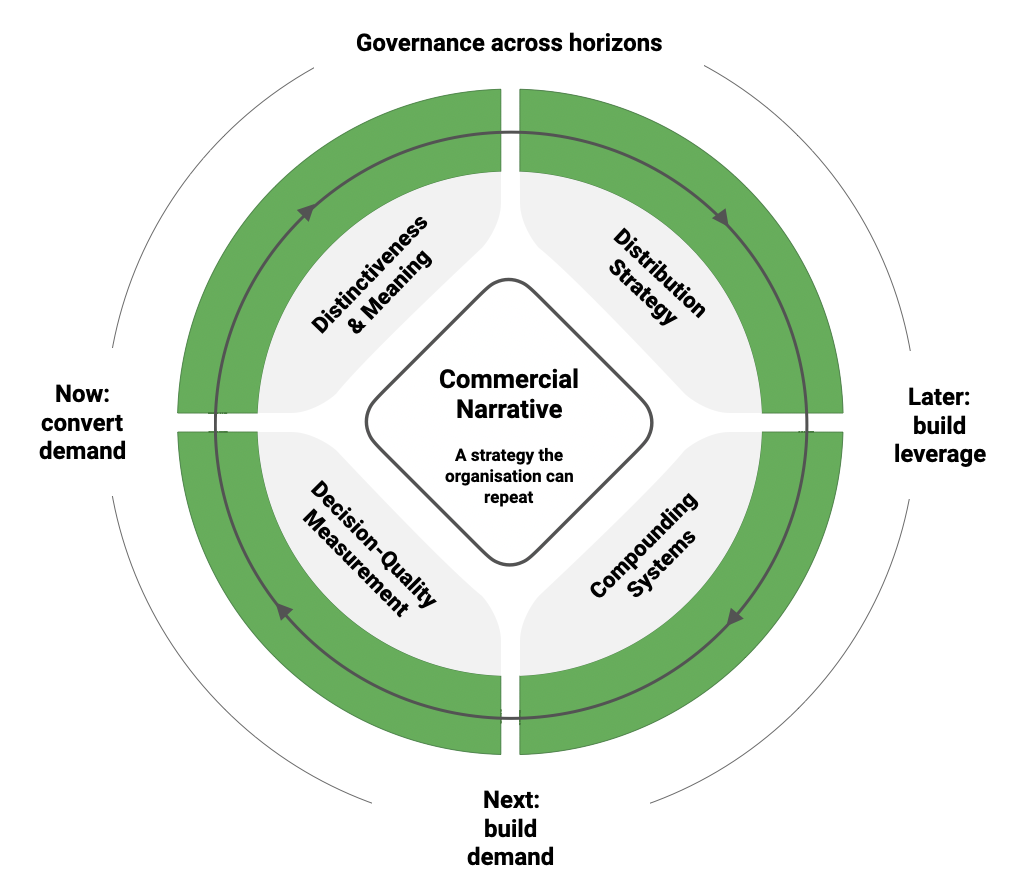
When business strategy is unclear, marketing strategy becomes guesswork. And this is the important part. This is also why I put “Commercial Narrative” at the centre of my 3-Horizon Momentum Model.
You get “we need more leads”, without a shared definition of lead quality or the economics behind it. You get “we need brand”, without clarity on what the brand is supposed to make people believe and why that belief matters commercially. You get “we need content”, without a view of what the content is meant to do in the buying journey.
That is not strategy. That is activity.
The hidden failure mode: marketing becomes the stand-in strategy team
Here is the part we do not talk about enough.
When strategy is unclear, marketing still has to operate. And because marketing sits closest to customer insight and market signals, it often becomes the default author of “how we win”.
Deloitte’s own framing of the modern CMO role explicitly points in this direction. CMOs can influence far beyond comms, transforming facets of the enterprise “from strategic planning to talent management to innovation” into customer-centric endeavours.
In other words, marketing is often expected to bring the outside-in view. It is invited (formally or informally) into strategic questions. That is not inherently bad. In the best organisations it is a strength.
The problem is what happens when marketing is forced into this role without the right inputs.
Marketing is biased, not in a moral sense, but in a structural sense…
- Marketing sees customer pain, messaging resonance, channel performance, demand patterns.
- Marketing does not always have a clear view of unit economics, capacity constraints, product roadmap realities, sales execution issues, pricing power, fulfilment risk, or retention dynamics.
So when marketing has to “write the story” without those inputs, the story tends to become a marketing narrative, not a commercial narrative.
It over-indexes on what marketing can control… brand, messaging, content, acquisition channels
and under-indexes on what actually determines commercial outcomes… offer quality, pricing, distribution constraints, sales motion, customer success, operational delivery.
This is one reason marketing ends up trapped in a credibility cycle. When the narrative breaks, the organisation does not say: “we lacked commercial strategy inputs.” It says: “marketing didn’t deliver.”
Gartner’s research on strategic dysfunction gives this a big, credible backbone. When marketing is supporting unclear, too many, or conflicting objectives, performance suffers.
And the downstream result is exactly what many CMOs report: struggling to prove marketing’s value and receive credit, and marketing being perceived as an expense rather than a strategic investment.
So the issue is not simply execution. It is governance, clarity, and the narrative the organisation is running on.
Why missing strategy breaks marketing specifically
Let’s make the mechanism explicit.
1) No strategy means no constraints, and without constraints there is no focus
If the business has not made choices, marketing cannot make meaningful trade-offs.
- Positioning floats because “who we are for” is not stable.
- Messaging becomes broad because the company is trying to keep every door open.
- Channel selection becomes “what we have always done” or “what looks good in a meeting”.
- Creative becomes interchangeable because it is not anchored to a distinctive edge.
Marketing becomes a layer of noise on top of ambiguity.
2) Measurement becomes a coping mechanism
When outcomes are unclear, proxies multiply.
It is not that measurement is bad. It is that measurement becomes a substitute for strategy.
You see this in the real world as…
- expanding dashboards
- KPI forests
- attribution obsession
- weekly reporting cycles that consume energy but do not create clarity
Even measurement leaders are starting to emphasise the same principle: tools do not create ROI, strategy does. Nielsen explicitly frames the need to align measurement strategy with core business goals if you want sustained ROI.
Which is exactly the point. If business goals are unclear, measurement becomes theatre.
3) Marketing becomes the scapegoat for commercial uncertainty
Marketing is a visible budget line, and it is one of the few functions that can be pressured for immediate “proof”.
So when the business is uncertain about growth, marketing takes the heat…
- “show me ROI”
- “why are leads down”
- “why is CAC rising”
- “why are we not growing faster”
Even when the binding constraint is upstream… weak product differentiation, pricing mismatch, slow sales follow-up, poor retention, operational bottlenecks.
This is the environment in which marketing loses trust, not because marketing suddenly became incompetent, but because the business is asking marketing to solve problems it cannot solve alone.
The fix: build a Commercial Narrative (not a brand story)
This is where I think a lot of organisations need a simple upgrade.
If the core problem is missing strategy clarity, the most useful thing you can create is not another plan, and not another deck, and not another dashboard.
It is a commercial narrative.
A commercial narrative is a short, repeatable story of how the company wins, and the logic that brings it all together…
market reality → strategic choices → why it will work → what we expect to see if it’s working
This is not a brand narrative. Brand narratives can be beautiful and still commercially useless.
A commercial narrative is operational. It becomes the spine of planning, alignment, and measurement.
What a strong commercial narrative includes…
- The market reality: what has changed, what is true now
- The customer priority: who we are focused on, what they are trying to achieve
- The edge: why us, why we are credible, why we win
- The trade-offs: what we are not doing
- The growth model: how demand is created and captured (route to revenue)
- The proof plan: the signals we expect to see over time (not vanity metrics)
There is strong support for the broader idea that high-performing organisations anchor marketing to business strategy. The HBR piece “The Ultimate Marketing Machine” is explicit, leaders of high-performing companies connect marketing to business strategy and to the rest of the organisation.
That is the core. It is not “marketing needs to do more.” It is “marketing needs a strategy spine to plan against.”
What changes when the commercial narrative exists
This is the payoff. When the narrative exists, you get compounding benefits across the system.
1. Planning becomes sharper
- Fewer initiatives.
- Clearer prioritisation.
- Better briefs.
- Less thrash.
Instead of “we need more leads”, you get “we are prioritising X segment because Y is changing, and our edge is Z, so our go-to-market focus is A and B, and we expect to see these signals.”
That is a plan you can govern.
2. Distribution becomes coherent
When the narrative is clear, channels stop being a shopping list.
Distribution becomes an extension of the growth model…
- Which channels best reach this customer in this buying context?
- Which channels reinforce our edge?
- Which channels can compound over time (instead of constantly paying rent)?
You stop trying to do everything, and you start building leverage.
3) Measurement becomes believable
The goal is not to measure everything. The goal is to measure what matters given the strategy.
With a commercial narrative…
- You use fewer KPIs.
- You accept longer time horizons where needed.
- You pick leading indicators tied to the growth model.
- You reduce attribution theatre because you have a better theory of value creation.
Again, this aligns with the measurement point: strategy first, tools second.
A quick diagnostic: how to tell if you are missing this
If you are reading this and thinking “this feels familiar”, check for these symptoms:
- Marketing goals change month to month.
- Everyone agrees “growth”, but disagrees on what drives it.
- Sales says “lead quality is down” but cannot define “good”.
- Every channel is considered “important”.
- Reporting volume increases as confidence drops.
- The board wants certainty that the environment cannot provide.
Here is the brutal test…
Can your exec team explain how you win in under 60 seconds, and all say the same thing?
If not, you do not have a commercial narrative. You have a set of activities.
The remedy: a Commercial Narrative sprint (one page, used everywhere)
The solution does not need to be heavy. In fact, it is better if it is light enough to actually get used.
The goal is a one-page “operating narrative” that becomes:
- the planning spine
- the briefing standard
- the sales alignment anchor
- the measurement reference point
The 5-question workshop…
- What changed in the market?
- Who are we prioritising, specifically?
- Why would they choose us over alternatives?
- What are we saying no to?
- What should we expect to see in 30/90/180 days if this is true?
The 30/90/180 framing matters because it forces the organisation to think in time horizons. This is also an important feature of my 3-Horizon Momentum Model. It also reduces the impulse to demand instant proof for everything, which is one of the drivers of reporting theatre.
And once the narrative exists, marketing stops acting as the stand-in strategy team. It becomes what it is supposed to be… the demand engine and the clarity amplifier.
How we can reframe this
Marketing can do a lot.
It can create demand. Shape perception. Build memory. Improve conversion. Increase distribution efficiency. Turn a business into a category leader.
But marketing cannot compensate for missing strategic choices.
If the business cannot commit to how it wins, marketing will be forced to improvise. Improvisation looks like activity. Activity looks like waste. Waste triggers scrutiny. Scrutiny triggers more reporting. And the cycle continues.
Gartner’s data suggests many teams are stuck in exactly this environment of unclear and conflicting objectives, and it is associated with weaker performance. And their research shows many marketing leaders struggle to prove value and receive credit in that environment.
So if you are a marketing leader feeling the ground shifting under your feet, consider this…
Your first job is not to produce a bigger plan.
Your first job is to secure a commercial narrative that the business actually owns.
Because marketing can amplify clarity.
It can’t replace it.